Tuesday, November 4, 2014

Text-to-Society: 12 Years A Slave


During our second memoir unit, I have been reading 12 Years a Slave, by Solomon Northup. A central idea found in 12 Years a Slave, is respect, and more specifically courtesy.

Solomon Northup is a freeman living in Saratoga Springs, New York with his wife, Anne, and their two children. Solomon leaves town with two white men, on what he thinks is an out of town violin gig. Instead, Solomon is kidnapped and sold into slavery under the name Platt, left with no evidence of his kidnapping. Solomon is at the mercy of his master and their associates, often being beaten and abused for the smallest mistake. Solomon meets and learns the stories of many slaves, the untold horrors they've experienced never cease to shock him. Solomon tries many times, unsuccessfully, to escape slavery, and eventually gives up all hope of returning to his family. That all changes when Canadian Abolitionist Bass, a carpenter, visits the plantation Solomon is a slave on to build the Master a new house. *Spoilers*. Solomon opens up to Bass about his life, and asks Bass to mail a letter to his friends in New York. Bass agrees and writes to Solomon's friends about his life and need of saving. The letter reaches a lawyer and friend of Solomon, who after a few months travels south to find Solomon. A chance meeting with Bass leads the lawyer and a town sheriff directly to Solomon, and Solomon is finally able to return to his family after 12 years.

Courtesy is a theme we see in everyday life. In my life courtesy is a common, natural way to act. You bump into someone in the hallway and your first thought is usually 'I'm so sorry', someone sneezes you say 'bless you'. Unfortunately for Solomon courtesy is not only lacking but completely nonexistent while he is a slave. Solomon's masters treat him like an animal, as if he is unable to form educated thoughts and understand simple directions. An article on courtesy discusses the writer's personal experiences with people who completely disregarding courtesy.  The writer goes further showing a question asked on a different site about courtesy and people's responses:


What's a common courtesy that has been lost?” The top five answers are as follows:
  1. Saying "please" and "thank you"
  2. Saying "you’re welcome"
  3. Saying "excuse me"
  4. Not swearing
  5. Holding a door
It's interesting to see the many opinions and views on courtesy, as we all have had different experiences. I, for example, often forget to be appreciative about courtesy, as I see courtesy constantly. But for people like Solomon and the writer of the article I read, courtesy is lacking in their lives, making them wish for it and want a change.
In case anyone is interested in reading the article: http://www.ksl.com/?sid=20364871

Sunday, November 2, 2014

A Wrinkle in Time: Meg Murry Qualities

I am currently reading A Wrinkle in Time, and I am in the middle of the book. The main character in A Wrinkle in Time is Meg Murry, a twelve year old plain Jane who happens to be the hero.  Meg's worst qualities,stubbornness and impatience, are the qualities that help Meg to defeat IT. For this reason I believe that Meg's worst and best qualities are the same. Madeleine L'Engle even states this, "“Meg, I give you your faults."
"My faults!" Meg cried.
"Your faults."
"But I'm always trying to get rid of my faults!""

Meg's stubbornness is especially noticeable while she's in school. At school Meg is called to the principal's office, again, and the principal tries to convince Meg to be more realistic, specifically about her father's whereabouts.
"“Meg, don't you think you'd make a better adjustment to life if you faced facts?"
I do face facts," Meg said.
They're lots easier to face than people, I can tell you.”"
In this example Meg refuses to let the principal tell her how to act and how to think. This proves to help Meg in the future when faced with IT, because while Charles Wallace listens to IT and becomes unable to form his own thoughts,  Meg acts stubborn and avoids capture.

Meg's impatience, while eventually helpful, starts as, in her eyes, a fault. In this example Meg and Mrs. Which are having a conversation about Meg's father, that quickly turns sour. Meg is horribly impatient and doesn't want to find out for herself where her father is, she wants to know immediately.
"“We are going to your father," Mrs. Which said.
"But where is he?" Meg went over to Mrs. Which and stamped as though she were as young as Charles Wallace."
In this example Meg's impatience causes her to act foolishly, although by this point of the novel Meg is starting to realizes that her impatience, her faults, can be used to her advantage.

Tuesday, October 14, 2014

A Wrinkle in Time: Explanation of Choice

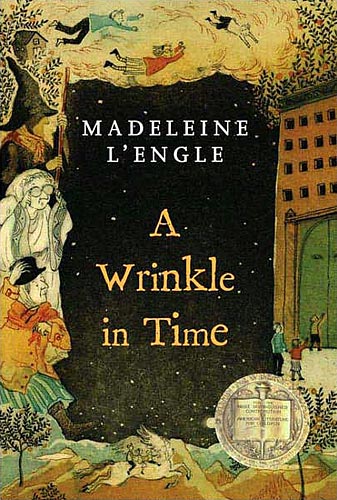
I am reading A Wrinkle in Time by Madeleine L'Engle. If I'm being honest, I have tried to read this before but didn't manage to read more than the first chapter. Last time I read it, I found the beginning slow moving and switched books because it was too boring.  When I was deciding what to read I first looked on Amazon for book suggestions. Another book by Madeleine L'Engle An Acceptable Time showed up and I was interested. An Acceptable Time was part of the Wrinkle in Time quintet, so I would have to start at the beginning.  When I pulled A Wrinkle in Time out again, the first thing I noticed was the cover. The cover is illustrated with the main characters and parts of the setting. Now that I'm reading the book, this is helpful to understand the character features being described, but when I was picking out the book I just thought it looked nice.

I am currently 80 pages into my reading, and I don't regret my choice to reread A Wrinkle in Time. The beginning is better then I remember, although there were sections I had to read multiple times to understand. I think the reason I could never finish this in the past is because of the details, you really  need to pay attention to what's going on in the book. For any reader's interested in this novel here is the back cover:
" It was a dark and stormy night.Out of this wild night, a strange visitor comes to the Murry house and beckons Meg, her brother Charles Wallace, and their friend Calvin O'Keefe on a most dangerous and extraordinary adventure- one that will threaten their lives and our universe. "


Wednesday, September 24, 2014

A Wrinkle in Time: About the Author


I am currently reading A Wrinkle in Time by Madeleine L'Engle . Madeleine L'Engle started writing stories, poems and journals in school, rather than doing her assigned schoolwork. Madeleine's mother studied to be a pianist and her father was a writer. After graduating from college, Madeleine's dream was to become a playwright, and she moved to New York to pursue this career. She thought that theater was a good start to learn how to become a successful playwright. While touring with the play Uncle Henry Madeleine wrote her first book, The Small Rain. Madeleine soon married Hugh Franklin, an actor,  and had three children. Madeleine decided to leave the theater, and her family moved to Connecticut. Her next book Meet the Austins was based off her experience in Connecticut while Hugh ran a general store. Madeleine was the Newberry Medal winning author of numerous books, she has written more than sixty. One of Madeleine's most famous books, A Wrinkle in Time, took more than two years to sell.


After winning the Newberry Medal for A Wrinkle in Time, Madeleine discussed children's books with the New York Times.  A Wrinkle in Time was the first of a junior novel series written by Madeleine. Madeleine says, "It's often possible to make demands of a child that couldn't be made of an adult ... a child will often understand scientific concepts that would baffle an adult." Madeleine says this is because of children's imagination. In A Wrinkle in Time, Madeleine does use multiple scientific concepts, including the idea of a tesseract. Madeleine also believes this is why so many authors turn to fantasy writing, a genre generally read by children.